

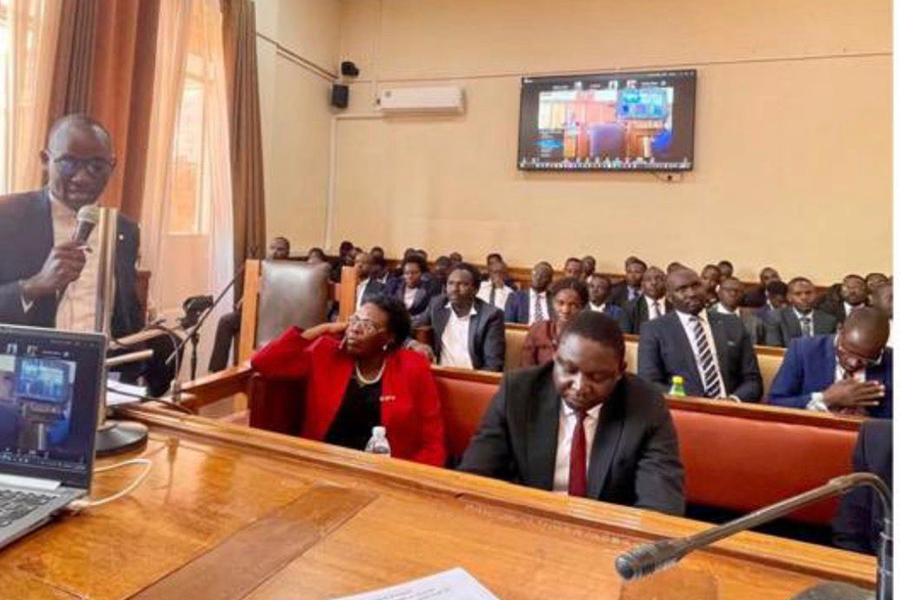
The Mbarara High Court Circuit has reaffirmed its commitment to strengthening collaboration and improving case management following a hybrid Bar–Bench meeting convened on Tuesday afternoon at the High Court premises in Mbarara.
The meeting brought together judicial officers, prosecutors and advocates practicing within the Circuit to enhance coordination and foster constructive dialogue between the Bench and the Bar.
The Deputy Registrar of the Circuit, Grace Atwongyeire, welcomed participants and commended them for their professionalism and cooperation over the past year.
She also extended a warm welcome to judicial officers recently transferred or deployed to the Circuit, noting that the engagement was intended to strengthen collaboration for more effective case management.
Highlighting the Court’s performance during the second quarter, Atwongyeire referenced targeted criminal sessions conducted in Mbarara, Ntungamo and Ibanda, the Settlement Fortnight held in November 2025, and the Plea Bargaining Camp conducted in December 2025 at Mbarara Prison.
She reported that the Court disposed of 766 cases against a target of 500, achieving a 153.2 percent disposal rate.
“Effective case management is a shared responsibility, and this performance reflects our collective effort to deliver people-centred justice in line with the Judiciary Client Charter,” she said.
The Head of the Circuit, Justice Allan Nshimye, commended stakeholders for their continued commitment to professionalism and collaboration.
He outlined key priority areas under the 6th Judiciary Strategic Plan (FY 2025/26–2029/30), including digital transformation and automation of court processes, reduction of case backlog, strengthening integrity and accountability, and enhanced stakeholder engagement.
Nshimye informed participants that the Circuit and selected Chief Magistrates’ Courts had been earmarked for the next phase of the rollout of the Electronic Court Case Management Information System (ECCMIS).
He also disclosed plans to operationalize Ibanda and Ntungamo High Court Circuits, noting that these measures would significantly ease workload and reduce backlog at Mbarara High Court.
He further encouraged advocates to embrace digital innovations and Alternative Dispute Resolution mechanisms, and to utilize the designated Mbarara Open Court Days held every Wednesday afternoon to raise issues affecting case management.
Representing the Bar, Counsel Collins Nuwagaba appreciated the Head of Circuit for institutionalizing regular Bar–Bench engagements and acknowledged progress made in improving case management.
He, however, highlighted challenges including delays in delivery of judgments in some cases, denial of costs in lower courts, inadequate staffing in registries, missing mother case files at the execution stage, and limited training for advocates on ECCMIS.
During plenary discussions, stakeholders proposed several recommendations, including structured training for advocates on ECCMIS, and fast-tracking the operationalization of Ibanda and Ntungamo High Court Circuits to reduce workload and travel costs.
They also called for dissemination of notices of expression of interest for appointment to the Roll of State-Appointed Advocates, appointment of Acting Judges and Magistrates to ease backlog, securing additional space and parking at Mbarara High Court to accommodate increasing court users, and deployment of additional support staff.
Among those in attendance were Justice Kwemara Kafuuzi Gelase, Resident Judge; Mushebebe Moses Nabende, 1st Chief Magistrate Mbarara; Okwong Stella Paculal, 2nd Chief Magistrate Mbarara; Seruwo Benjamin, Chief Magistrate Kiruhura; Tukundane Patience Lorna, Chief Magistrate Isingiro; and Magistrates Grade One including Alex Baguma, Racheal Tabaruka, Edgar Kakuru, Sheeba Nasasira, Yafesi Ochieng, Ruth Mugisha and Rekyeraho.
The engagement underscored the Circuit’s continued focus on collaboration, innovation and accountability as key drivers in delivering timely and effective justice.
